


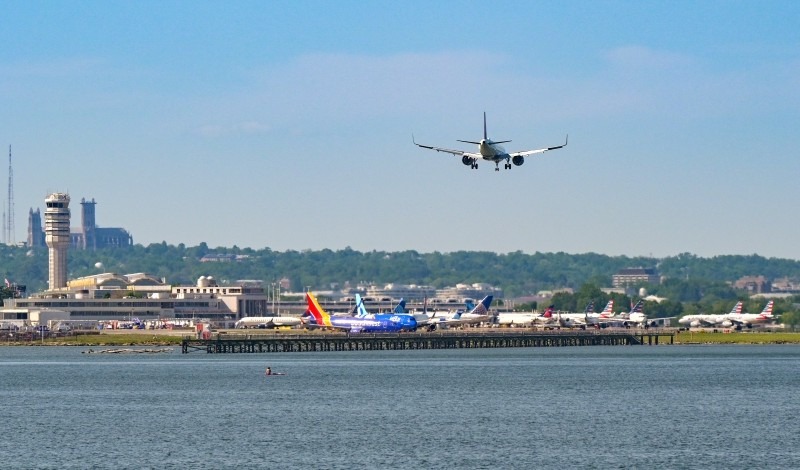
Minutes before its scheduled landing on January 29, 2025, an American Airlines plane carrying 60 passengers and four crew members plummeted into the Potomac River in Washington, D.C., after colliding with a military helicopter. All 64 people on board perished.
Although the cause of the accident remains under investigation, a report by the Federal Aviation Administration (FAA) reveals that the airport’s staffing level at the time of the accident was “not normal,” with one air traffic controller handling the work normally assigned to two people.
Although such tragedies are rare, there have been many near misses involving commercial airlines in recent years. In the 2022-2023 fiscal year, the FAA reported 503 air control lapses that the agency categorized as “significant,” representing a 65 percent increase from the previous year. Most of the close calls occurred near airports with high volumes of air traffic, and they often involved errors by air controllers or pilots.
The increasing frequency of aviation incidents raises questions about flight safety. In the United States, the FAA regulates all civil aviation and sets safety standards for commercial aircraft. One of its most critical responsibilities is overseeing air traffic control. The agency develops air traffic rules, allocates airspace usage, and operates a national network of airport towers to ensure the safety of millions of passengers traveling through U.S. airspace each year.
Currently, over 90 percent of the 313 air traffic control facilities in the United States operate below FAA-recommended staffing levels. Among them, 73 facilities have at least a quarter of the positions unfilled. To compensate for these shortages, the FAA has required air traffic controllers to work extended hours.
The staffing shortage partly stems from training disruptions during the COVID-19 pandemic. Becoming an air traffic controller requires a lengthy and rigorous certification process, and pandemic-related training pauses delayed the certification of new controllers while many experienced ones retired.
Yet the shortage is likely to persist. The day after the D.C. plane crash, the U.S. Office of Personnel Management (OPM) sent an email urging federal employees to seek “more productive” jobs in the private sector. “The way to greater American prosperity is encouraging people to move from lower productivity jobs in the public sector to higher productivity jobs in the private sector,” the message stated.
In addition to the OPM communication, FAA employees also received an offer to resign with eight months’ pay. If a large number of controllers accept the employment buyouts, the already strained workforce could shrink even further.
Critics argue that the administration’s efforts to downsize the federal government will only worsen the air traffic controller shortage. Losing experienced personnel amid an ongoing staffing crisis, they warn, could heighten safety risks and increase the likelihood of midair collisions.
In this week’s Saturday Seminar, scholars discuss current regulations on aircraft safety.
- In an article in the Journal of Space Law, Nilgun Özgür and Steven Truxal of the Netherlands’ Leiden University examine how increasing commercial space operations have created new challenges for aviation safety. Özgür and Truxal note that recent growth in the space economy has led to more frequent spacecraft traffic, creating potential hazards for civil aviation and air traffic management. They suggest that international law is presently inadequate to address these new challenges. Özgür and Truxal argue that the International Civil Aviation Organization must take a stronger role as a “global regulatory authority” to harmonize integrated airspace operations standards. A collaborative regulatory management system, Özgür and Truxal conclude, is key to achieving greater safety for both civil and space aviation.
- In an article in the Journal of Air Law and Commerce, Goran Petrović, a lecturer at Serbia’s College of Applied Studies Aviation Academy, discusses the role of and challenges facing non-governmental organizations (NGOs) in civil aviation. Petrović notes that despite having differing views on a wide array of subjects, many civil aviation NGOs ultimately work toward a similar set of safety goals, integration of new technologies, bolstering of environmental protections, and implementation of training programs. The author discusses the United Nations’ Economic and Social Council, which has helped different international NGOs coordinate their activities and goals. Petrović also highlights how the increasing role of international NGOs reflects the increasing democratization of international law.
- In a recent article in the University of Illinois Law Review, practitioner Kevin Collareno argues that urban air mobility (UAM), which employs short-range electric aircraft, could reinforce existing air-transportation inequities if regulators fail to act decisively. Collareno contends that high certification costs, strict air taxi operating rules, and an overtaxed airspace system raise expenses. High costs concentrate the benefits of air transportation systems in wealthy areas, Collareno explains, leaving low-income and geographically peripheral communities with limited air-transportation service. Collareno urges lawmakers to act quickly to establish clear, predictable UAM certification procedures, create dedicated flight corridors in urban airspace, and standardize state rules for landing facilities to combat inequities before UAM technology becomes widespread.
- In an article in the Air & Space Lawyer, practitioner Jol A. Silversmith examines the conflict between local governments and federal oversight of airport operations. Many municipalities across the country attempt to exercise control over local airports to combat perceived impacts, such as noise and environmental harms, Silversmith observes. Yet airports that accept federal funds must abide by grant assurances that restrict local control, and local attempts to limit late-night flights or prohibit the use of leaded fuels face preemption by various federal statutes, he explains. Silversmith concludes that such federal supervision is preferable to greater local control because maintaining open airport access remains essential for a robust national air-transportation system and economic progress.
- In an article in the Ohio State Law Journal, Troy A. Rule of Arizona State University Sandra Day O’Connor College of Law discusses the treatment of landowners’ airspace rights in the United States. In recent years, Rule notes, companies such as Amazon and Walmart have pushed to override landowners’ rights to control low-altitude airspace above their properties. But Rule argues that embracing landowners’ airspace rights through modern sharing platforms could help the industry achieve widespread deployment more quickly and sustainably. Rule proposes a digital sharing system where landowners could voluntarily license their low-altitude airspace to drone operators in exchange for fees. To implement this system, Rule recommends legislation strengthening aerial trespass protections and clarifying drone jurisdiction and airspace rights.
- In an article in the Journal of Air Law and Commerce, practitioners Christine Kranich and Sarah Joanna Haas discuss the “book-and-claim” regulatory framework. According to Kranich and Haas, a book-and-claim system is intended to lower the costs of sustainable airline fuels. They describe the book-and-claim model as being similar to block-chain technology: Airlines would be permitted to purchase sustainable fuels that could be used by other companies or in other airports. Any carbon-cutting benefits, as regulated by global institutions such as the European Union Emissions Trading System, would be attributed to the purchaser, rather than the consumer, of the sustainable fuel. Kranich and Haas conclude that this system would improve corporate transparency, reduce carbon output, and cut administrative costs.