


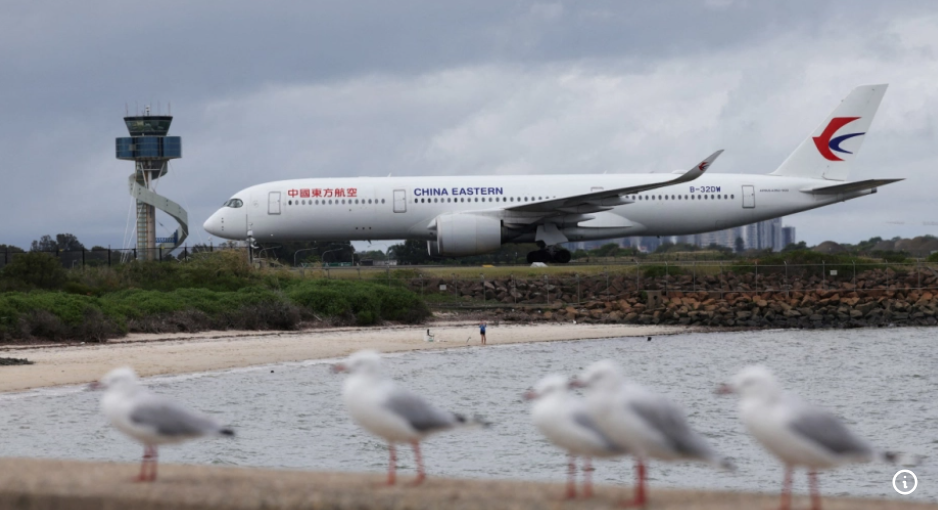
China’s three largest state-owned airlines have issued warnings regarding their financial outlook for the current year, acknowledging that the eruption of war involving Iran has driven jet fuel prices to unsustainable highs.
The Chinese aviation industry, which has been battling persistent oversupply and aggressive price wars in the domestic market, is now heavily exposed to the macroeconomic fallout of the Middle East crisis. This geopolitical shock has overshadowed what was initially expected to be a robust year for global aviation.
“The impact of geopolitical conflicts will persist, and the overall momentum of global economic growth will remain insufficient,” Shanghai-based China Eastern Airlines stated bluntly in its annual report, which was published late on Monday.
Q4 losses erase summer gains
The financial trajectory of the “Big Three” over the past year highlights the sector’s fragility. Air China, China Eastern, and Guangzhou-based China Southern Airlines had all managed to claw their way back to profit in the third quarter of 2025, riding a wave of strong domestic summer travel demand.
However, they struggled to maintain that altitude. Aggressive capacity expansion by all carriers resulted in an oversupplied market according to analysts. This, coupled with intensifying competition from China’s sprawling and highly efficient high-speed rail network, forced airlines to slash ticket prices to maintain passenger volumes. The resulting margin compression was severe.
China Southern slipped back into the red in the fourth quarter, reporting a loss of 1.3 billion yuan (£152 million), although it held the distinction of being the only carrier of the trio to post a marginal full-year profit for 2025. China Eastern fared worse, posting a fourth-quarter loss of 3.7 billion yuan (£433 million). Meanwhile, Beijing-based Air China, the nation’s flagship carrier, reported a loss of 3.64 billion yuan (£426 million) for the same period last week.
To counter domestic weakness, all three airlines had pivoted toward the international market as a primary growth driver. For the full year of 2025, China Eastern recorded a robust 22.7% rise in international passenger traffic, while China Southern and Air China posted increases of 19.6% and 15%, respectively. Yet, even this strategy faced geopolitical headwinds. International operations came under intense pressure in the fourth quarter when the carriers were forced to sharply cut capacity to Japan following a mid-November government travel advisory linked to bilateral tensions, a move that also forced them to absorb the costs of mass free refunds.
Impact of the Iran conflict
While domestic overcapacity and regional tensions are problematic, the overriding threat for 2026 is the cost of kerosene. According to aviation data platform Flight Master, Chinese airlines actually carried a record 94 million passengers during the 40-day Spring Festival travel rush in the first quarter of this year, a 4.7% year-on-year increase. But volume no longer guarantees profit.
Analysts have cautioned that the revenue boost from this holiday demand will almost certainly be incinerated by sharply higher fuel costs. Prior to the outbreak of the Iran war last month, the global airline industry, via the International Air Transport Association (IATA), had forecast record collective profits of $41 billion for 2026. However, with jet fuel prices more than doubling in a matter of weeks, those forecasts have been shredded, forcing carriers worldwide to rethink their network viability.
Among the Chinese “Big Three,” only China Eastern demonstrated the foresight to actively manage its jet fuel price risk through hedging in 2025. According to its annual report, as of December 31, 2025, the airline held outstanding jet fuel hedge positions of 500,000 barrels, scheduled to expire in 2026. While helpful, the carrier’s own sensitivity analysis lays bare its exposure: a mere 5% move in average jet fuel prices results in a 2.2 billion yuan (£257 million) impact on its total profit.
The situation is dire for the unhedged carriers. According to analysts at HSBC, fuel already accounted for a staggering 35% to 38% of the trio’s operating expenses in the first half of 2025 – a figure that will be significantly higher now. Furthermore, China’s regulatory environment restricts airlines from passing these costs onto consumers immediately. Because the domestic fuel surcharge mechanism tends to lag significantly behind spot market prices, and rarely fully offsets the higher costs, rising oil prices will directly and rapidly erode profit margins.
“We think aggressive fuel surcharge implementation would risk demand destruction that proves self-defeating, especially in China, where high-speed rail offers a compelling substitute at a much lower cost than economy airfares,” the HSBC analysts noted in a recent brief to clients. Consequently, HSBC projects that the three carriers will post even deeper losses throughout 2026, pushing the timeline for a return to sustainable profitability out to 2027.
Oil tanker off Dubai hit by Iranian strike, Trump threatens to obliterate Iran’s energy
U.S. weighs early end to Iran war despite Hormuz closure – Middle East conflict on 31 March
Iran says U.S. peace plan is ‘unrealistic’ as oil prices rise
Amidst the financial gloom, the airlines are continuing their fleet modernisation, notably with deliveries of the COMAC C919, China’s homegrown narrow-body jet designed to challenge the Airbus A320 and Boeing 737 monopolies.
Though deliveries in 2025 fell short of expectations, China Southern has lifted its expectations for 2026 deliveries to 13 aircraft from eight previously, while China Eastern and Air China both maintained their forecasts of receiving 10 jets each this year.