


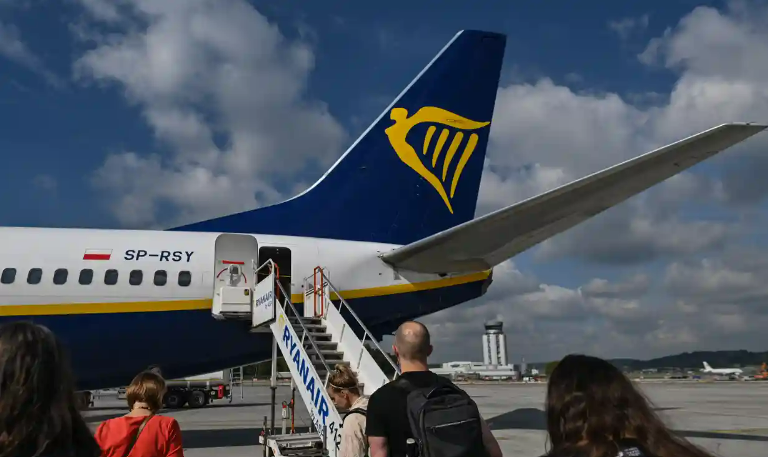
A controversial new cut in air passenger tax due next month was passed after the airline industry told the government it would lead to a new era of “ultra low” prices for domestic flights in the UK, with one airline predicting a 31% rise in passengers, industry documents reveal.
The new cut in air passenger duty (APD) for domestic flights was approved by Rishi Sunak when he was chancellor, halving the price to £6.50 from 1 April. The rail industry has warned the move could increase carbon emissions by 27,000 tonnes a year and result in 220,000 fewer rail journeys a year.
Industry submissions obtained under freedom of information laws by openDemocracy reveal how the airlines lobbied for the duty cut to boost air travel in the UK, despite a drive to cut carbon emissions.
Ryanair in its submission to the March 2021 consultation said it would be able to offer more domestic flights at low prices, pointing out that in Spain internal flights could be booked for as little as €5 (£4.42). The low-cost airline has unveiled a number of new UK domestic routes since the cut in duty was announced, including London Stansted to Cornwall.
The airline also rejected a frequent flyer tax which would have progressively increased the fees for each flight taken. It argued it would be “likely only to punish passengers that have an ongoing practical requirement to fly frequently”.
EasyJet said in its submission: “Our analysis shows that if domestic APD is reduced by 50%, this would support an overall 31% increase in domestic volume, to 10.6 million passengers.” BA’s owner, International Airlines Group, told the Treasury that “positive outcomes could include new routes, increased frequency and larger aircraft on existing routes as well as lower fares”.
International flights will see an increase in duties from April. The duty for most economy long-haul flights from 2,000 to 5,500 miles will increase from £84 to £87. Economy flights of more than 5,500 miles will be subject to a duty of £91.
Sunak, who is a regular user of private flights across the country, announced the cut in APD for domestic flights in the autumn budget in October 2021. Ministers rejected a recommendation by the Climate Change Committee, the government’s climate advisers, for a frequent flyer tax.
The aviation industry says the cut in duties on domestic flights will boost routes that are not served by rail and help support regional economies, but environmental campaigns have criticised the move.
Silviya Barrett, director of policy and research at the Campaign for Better Transport, said: “Not only will it encourage more polluting travel, but it will reduce revenue which could and should be invested in sustainable alternatives.”
Airlines UK, the trade body for registered airlines, said: “The UK’s domestic air connectivity plays a vital role linking the nations and regions. It does not mean compromising the sector’s commitment to achieving net zero carbon emissions by 2050.” EasyJet said in a statement: “We welcome this first step in reforming APD. EasyJet only operates domestic flights where there is no direct train journey of less than three hours.”
A government spokesperson said: “We are absolutely committed to levelling up the UK and delivering on our net zero commitments, which is why from April we are cutting duty in half for flights within the UK, except for private jets, and introducing new higher rates of duty for ultra-long haul flights.
“We consulted on a frequent flyer levy in 2021. We concluded that APD should remain the principal tax on the aviation sector.”
… as 2023 gathers pace, and you’re joining us from Jordan, we have a small favour to ask. A new year means new opportunities, and we’re hoping this year gives rise to some much-needed stability and progress. Whatever happens, the Guardian will be there, providing clarity and fearless, independent reporting from around the world, 24/7.
Times are tough, and we know not everyone is in a position to pay for news. But as we’re reader-funded, we rely on the ongoing generosity of those who can afford it. This vital support means millions can continue to read reliable reporting on the events shaping our world. Will you invest in the Guardian this year?
Unlike many others, we have no billionaire owner, meaning we can fearlessly chase the truth and report it with integrity. 2023 will be no different; we will work with trademark determination and passion to bring you journalism that’s always free from commercial or political interference. No one edits our editor or diverts our attention from what’s most important.
With your support, we’ll continue to keep Guardian journalism open and free for everyone to read. When access to information is made equal, greater numbers of people can understand global events and their impact on people and communities. Together, we can demand better from the powerful and fight for democracy.