


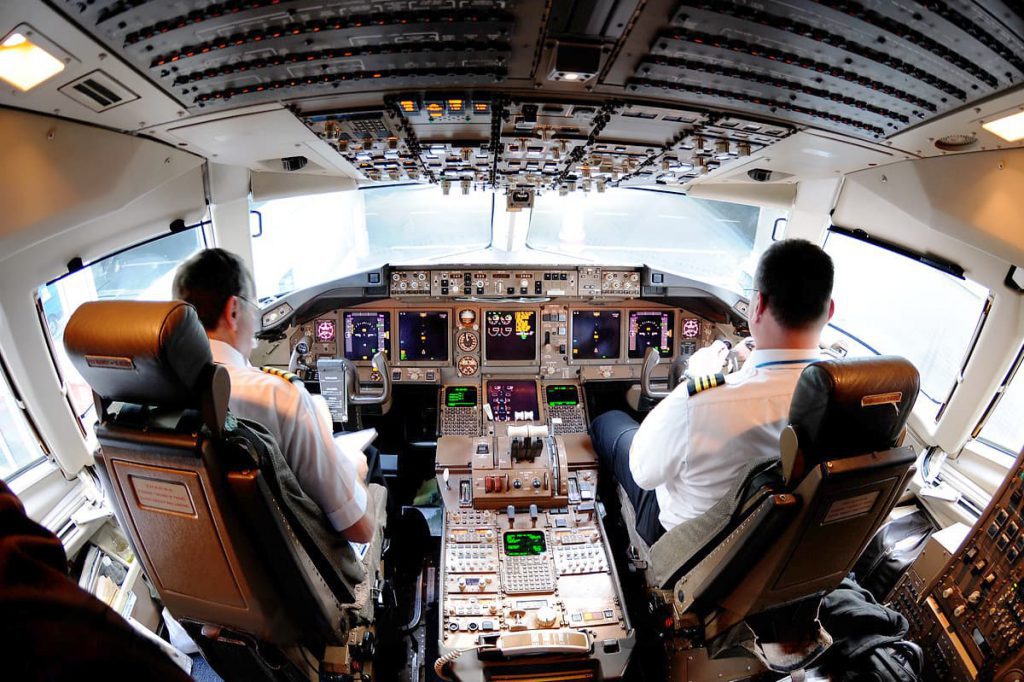
A close acquaintance recently admitted that when she boards an airliner she always takes a peek into the cockpit before turning to find her seat.
That doesn’t surprise me. The cockpit is a land of mystery and intrigue that calls out to so many of our non-pilot brothers and sisters. The gauges, switches, lights, and breakers were a visual cacophony of delight in the old days. Now a smattering of glass panels suggest the pilots might be monitoring multiple streaming providers to fight off boredom. Perhaps the captain is binge-watching “Better Call Saul” on one side while the first officer is re-watching “Breaking Bad” on the other.
Of course those glass panels actually serve a great function — a purpose that escapes the understanding of the average traveler.
Then again, pilots themselves sometimes miss the point of what their tools or procedures are all about. I suspect any of us who are honest with ourselves about the level of ignorance we carried when we began this journey would agree. Those who would argue the point tend to unintentionally display their continued lack of understanding.
Stalls are a good example of the phenomenon of misunderstanding. We tend to grasp onto what appears to be obvious, only to find later we should have been reading between the lines.
Initially, many flight students hear the term “stall” and immediately shudder at the thought that they’ll be airborne with a dead engine that won’t start. I believe I suffered from that misconception for a short time.
And why wouldn’t I? The term wasn’t unknown to me. It was the context that was new. Hence, confusion and misunderstanding rule the day until an important lesson is learned.
Our secondary misunderstanding about stalls tends to be that performing the stall well is an important part of our flight training — and perhaps the most nerve-wracking procedure we’re compelled to demonstrate to our instructor and our examiner.
In a very real sense, the only reason we are required to stall an airplane in the testing environment is so we can demonstrate our ability to recover from the stall. There is no standard listed in the ACS for how much altitude we can gain, only the amount we’re allowed to lose. We can perform the power on stall (formerly known as a departure stall) at any power setting above 65%. Full throttle may be how our CFI taught it to us, but full throttle is not a requirement.


Perhaps because how we choose to demonstrate the stalling of the airplane is not all that big a deal — it’s the recovery that matters. And it matters a lot.
Can you imagine what the traffic would look like at LAX, ORD, or EWR if every arriving transport category aircraft flew the full approach, procedure turn and all? It would work, but it wouldn’t be the most efficient use of crews, ATC, flight time, or fuel.


At the end of that full approach, CFIIs will often have their students go missed, mostly for the efficient use of their flight time. A series of missed approaches allows for more approaches in the time allocated for a lesson. But if the student always goes missed, and if they always go missed at the missed approach point, and if they never actually shoot the approach to a landing, have they really understood what the purpose of the approach and going missed is?
In real life we might initiate a missed approach because we’re not stabilized, or because we’re not fully set up for the approach, or because we encounter unanticipated traffic along our path of flight, or an obstacle of some sort, flocks of birds included.
Why not break off the approach two miles out now and then? Why not go for the full approach and landing occasionally? Landing is the point of the procedure. Going missed is the fallback position if we don’t get the runway environment in sight. Why teach only one outcome to the exclusion of others?
IFR flight has to include an understanding that we’re on the lookout for the expected (the runway) and the unexpected (anything other than a clear view of the runway). Either way, our job as a pilot is to understand, apply our skills, and deal with the situation safely.
What we know and what we think we know are two very different things. Whether we’re in training or at the end of long years of service, we would do well to keep our eyes and our options open.
After all, the passengers aren’t the only ones who don’t have a complete understanding of what’s happening up in the front seats. Each of us should routinely be open to learning.
It’s a far safer perspective than the ego-soaked alternative.