


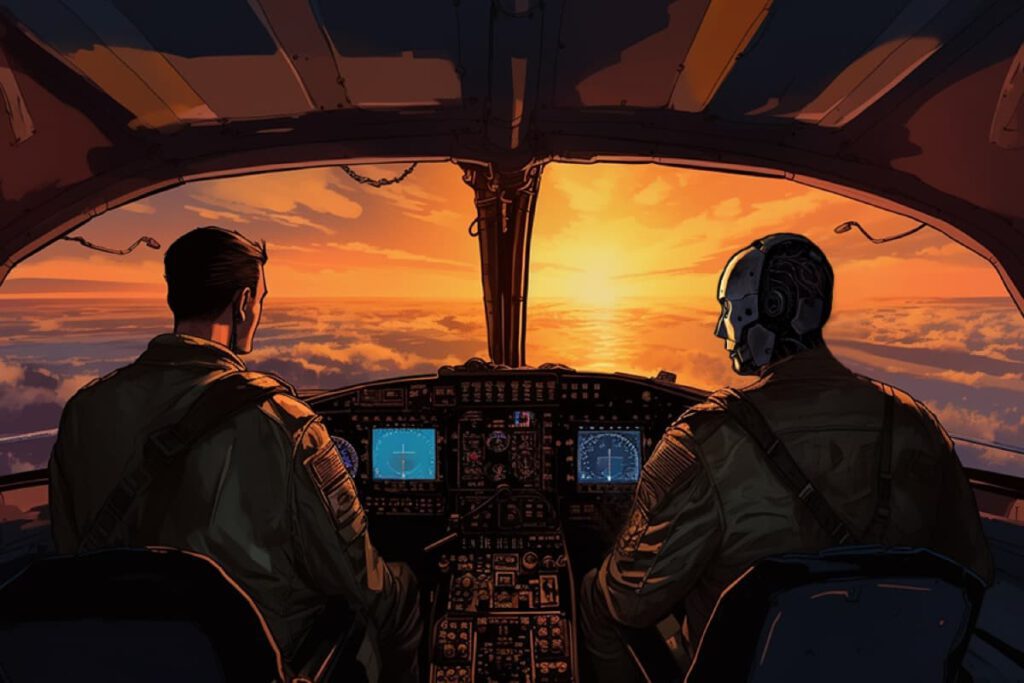
Aviation news international – Imagine you’re flying your airplane, but you aren’t the only one in control.
Your co-pilot is a computer, which also has its “hands” on the controls.
You and your co-pilot are on the lookout for different things.
If you are both paying attention to the same thing, you — as the human — are in control. But if you get distracted or miss something, the computer takes over.
That’s the idea behind Air-Guardian, a system developed by researchers at the MIT Computer Science and Artificial Intelligence Laboratory (CSAIL).
As pilots grapple with an onslaught of information from multiple monitors, especially during critical moments, Air-Guardian acts as a proactive copilot, researchers said, explaining the partnership between human and machine is rooted in understanding attention.
But how does it determine attention?
It begins with eye-tracking, according to the researchers. In addition, it relies on the neural system and something called “saliency maps,” which pinpoint where attention is directed.
The maps serve as visual guides highlighting key regions within an image, aiding in grasping and deciphering the behavior of intricate algorithms, researchers explained.
“An exciting feature of our method is its differentiability,” says Lianhao Yin, an MIT CSAIL researcher and lead author on a new paper about Air-Guardian. “Our cooperative layer and the entire end-to-end process can be trained. We specifically chose the causal continuous-depth neural network model because of its dynamic features in mapping attention.”
“Another unique aspect is adaptability,” he continued. “The Air-Guardian system isn’t rigid — it can be adjusted based on the situation’s demands, ensuring a balanced partnership between human and machine.”
In field tests, both the pilot and the system made decisions based on the same raw images when navigating to the target waypoint.
Air-Guardian’s success was gauged based on the cumulative rewards earned during flight and a shorter path to the waypoint. The guardian reduced the risk level of the flights and increased the success rate of navigating to target points, the researchers discovered.
Air-Guardian heralds a new age of safer skies, offering a reliable safety net for those moments when human attention wavers, according to MIT officials.
“The Air-Guardian system highlights the synergy between human expertise and machine learning, furthering the objective of using machine learning to augment pilots in challenging scenarios and reduce operational errors,” says Daniela Rus, a professor of electrical engineering and computer science at MIT, director of CSAIL, and senior author on the paper.
“One of the most interesting outcomes of using a visual attention metric in this work is the potential for allowing earlier interventions and greater interpretability by human pilots,” says Stephanie Gil, assistant professor of computer science at Harvard University, who was not involved in the work. “This showcases a great example of how AI can be used to work with a human, lowering the barrier for achieving trust by using natural communication mechanisms between the human and the AI system.”
For more information: MIT.edu
source: https://generalaviationnews.com/2023/10/07/will-you-have-an-ai-co-pilot-one-day/