Today in Aviation History: Sputnik 1, The World’s First Artificial Satellite, is Launched Into Orbit
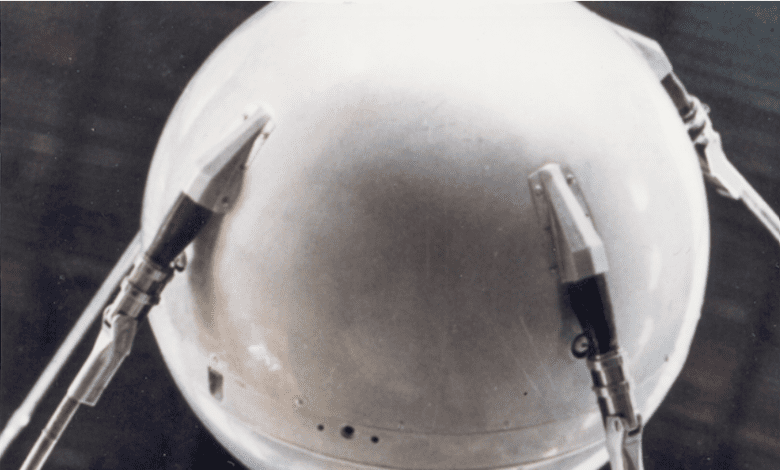
On October 4, 1957, Earth received its first artificial satellite companion, Sputnik 1. The Soviet Union packed its celestial dreams of space exploration into a sphere and launched it into the sky, creating history and competition among other western nations. The Sputnik 1 was the world’s first artificial satellite, designed to gather data on Earth’s upper atmosphere and test the viability of satellite communication. It was launched as part of the International Geophysical Year (IGY), a worldwide initiative to advance scientific knowledge through international cooperation, specifically in space and Earth sciences.
Designing the Sphere
The Sputnik 1 was designed at OKB-1, a design agency responsible for most of the USSR’s early space technology. The designing team was led by Sergei Korolev, often referred to as the father of the Soviet Union’s success in space. On December 17, 1954, Sergei proposed a development plan for an artificial satellite to Dimitri Ustinov, the Minister of Defense at the time, and forwarded a report with an overview of similar projects by other nations. After that, several discussions and plans were made by the Soviet Union announcing and designing a satellite, but the complexity of several projects like Object-D made it more challenging to implement in a short time.
The OKB-1 then stepped in, fearing the U.S. would launch a satellite before the USSR, and suggested the creation and launch of a satellite in April–May 1957, before the IGY began in July 1957. Hence, Sputnik 1 came into existence with the help of Mikhail S. Khomyakov, the chief constructor of Sputnik 1 at OKB-1. Not much later, on February 15, 1957, the USSR Council of Ministers approved this simple satellite. It was designated as ‘Object P.S.,’ P.S. meaning “prosteishiy Sputnik” or “elementary satellite.”
Unboxing the Sputnik
The Sphere
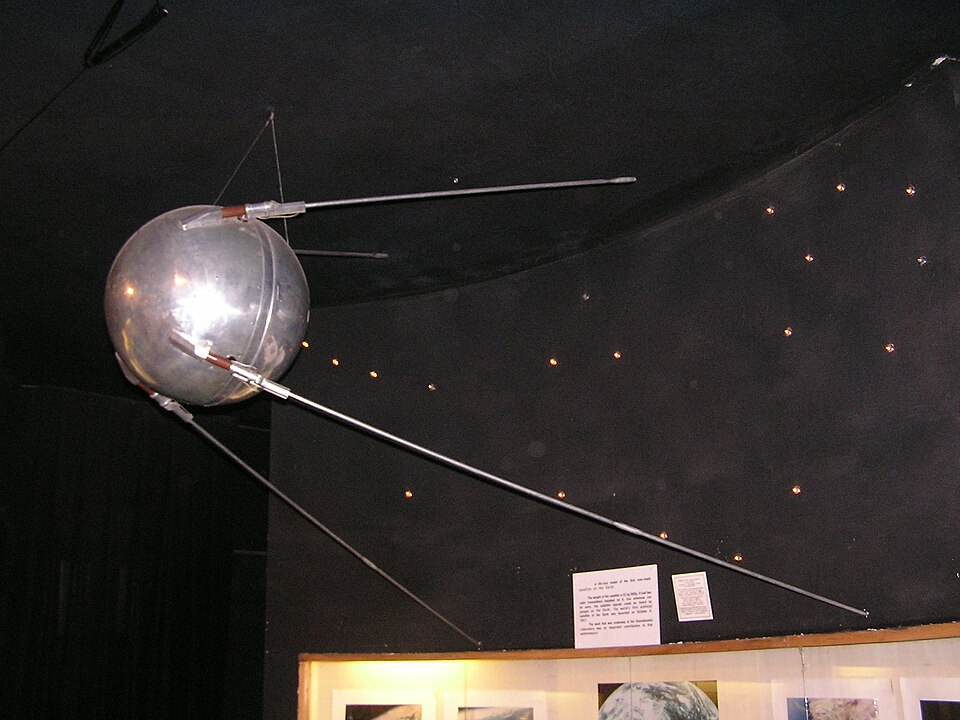
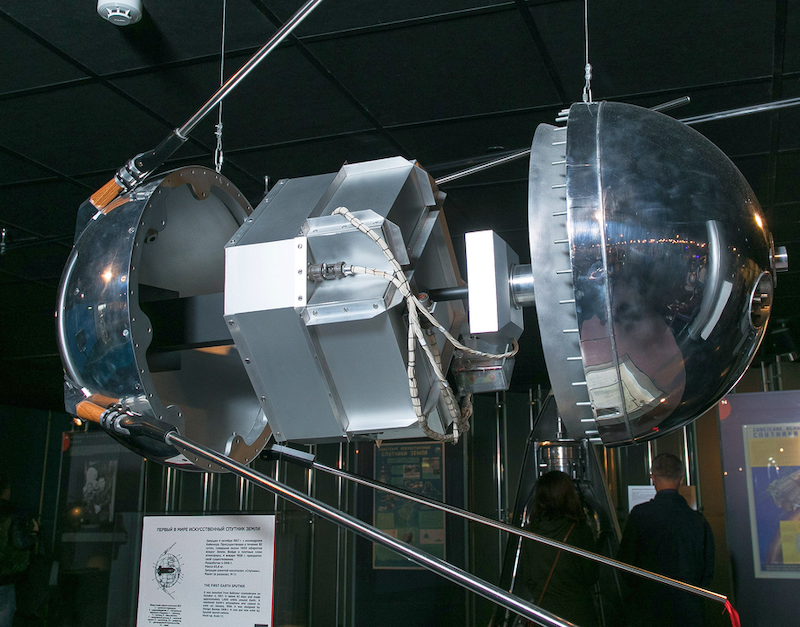
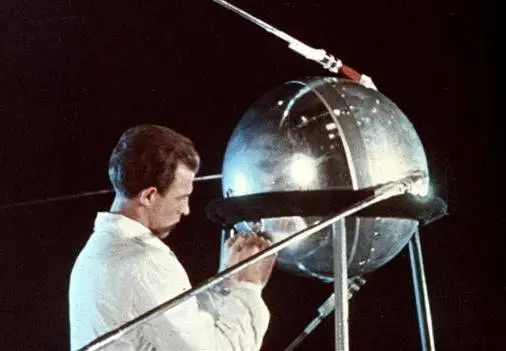
Based on the USSR’s previous complex satellite projects, Sputnik 1 was designed to be simple and reliable and able to be adapted to future projects as well. It had a polished metal spherical body 58 cm in diameter and 184 lbs of weight. The spheres were assembled from two hemispheres (2 mm thick) hermetically sealed with O-rings. These helped determine atmospheric density from its lifetime in orbit. To ensure the satellite was lightweight, an aluminium alloy was used for its construction, and the hemispheres were polished with an aluminium-magnesium-titanium alloy (AMG6T). The polish provided the satellite with a heat shield and durability in space conditions. The interior of the sphere was filled with dry nitrogen gas, which helped it maintain structural integrity in the vacuum of space.
The Antennas
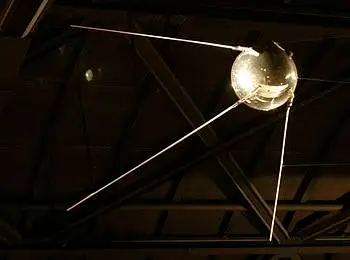
Additionally, the satellite carried two pairs of external antennas on the sphere, almost like whiskers, which created an omnidirectional spherical radiation pattern. This pattern enabled a consistent signal as the satellite orbited the Earth, transmitting signals across two frequencies.
Power Supply
The power supply automatically turned on the moment the satellite separated from the second stage of the rocket. This power supply was in the shape of an octagonal nut with the radio transmitter in its hole. It consisted of three silver-zinc batteries, two of which powered the radio transmitter and one powered the temperature regulation system.
The Launch
Sputnik 1 was launched on October 4, 1957, at 1928 UTC from the Baikonur Cosmodrome in present-day Kazakhstan using the R-7 rocket. It was also known as Sputnik 8K71PS, a modified intercontinental ballistic missile. Sputnik 1 was protected by a cone-shaped payload fairing while attached to the rocket. The launch was a roller coaster ride, as several engines did not fire on time, almost aborting the mission. A fuel regulator in the booster also failed around 16 seconds into launch.
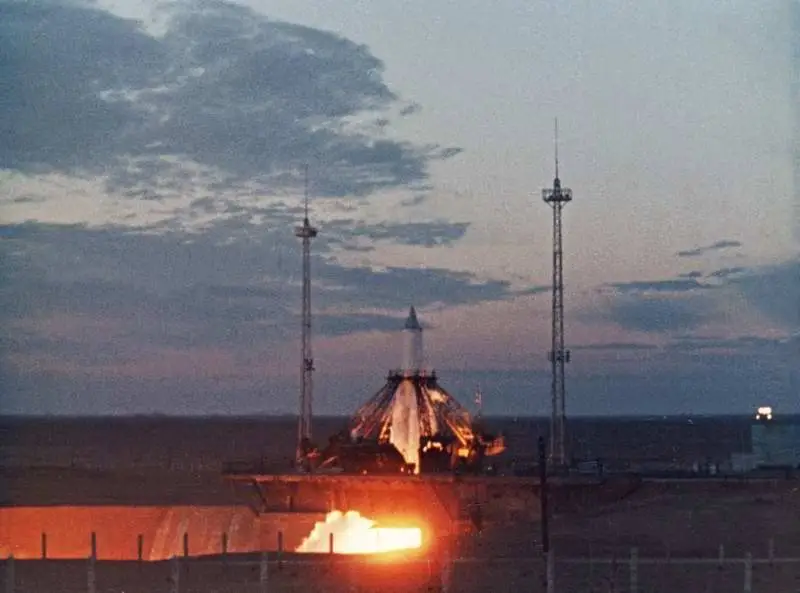
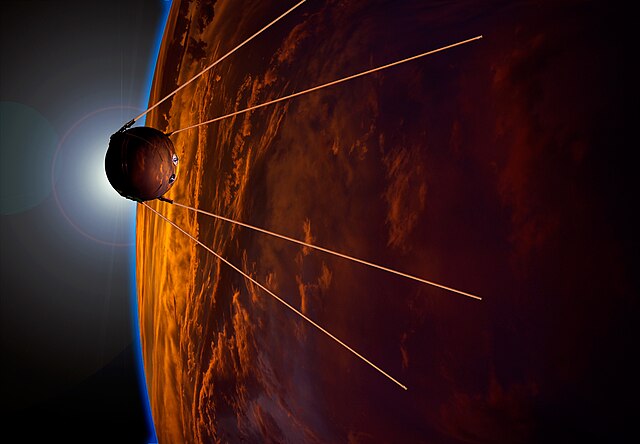
Eventually, at 19.9 seconds after the engine cut-off, PS-1 separated from the second stage, and the satellite’s transmitter was activated. The transmitter signals were detected at the IP-1 station, where the reception of Sputnik 1’s “beep-beep-beep” tones confirmed that the satellite had successfully been deployed. The unmanned satellite then entered a low Earth orbit, with an apogee (highest point) of 939 km and a perigee (lowest point) of 215 km.
The Orbit and the End
Once in orbit, Sputnik 1 maintained an orbital speed of approximately eight km/s and completed one orbit every 96.2 minutes. The satellite remained in orbit for 21 days, transmitting signals back to Earth. These signals sparked a widespread interest in space as they were detected by radio operators across the globe. However, the batteries ran out on October 26, 1957, after the satellite completed 326 orbits.
Even after the batteries failed, the core stage of the R-7 rocket remained in orbit for two months until December 2, 1957. Sputnik 1 itself continued to orbit for another three months and completed 1,440 orbits of the Earth. The satellite burned up in a glorious end while re-entering Earth’s atmosphere on January 4, 1958.
Some Heroes wear Antennas for Capes
Several replicas of the Sputnik 1 satellite have been showcased at museums in Russia, and another is on display at the Smithsonian National Air and Space Museum in Washington, D.C. The launch of Sputnik 1 was a defining moment in the history of space exploration, triggering a new era of scientific discovery and international competition. Its technological accomplishments, although simple by today’s standards, laid the groundwork for more complex space missions. The Sputnik 1 sparked the space race and fundamentally forever altered humanity’s relationship with space.
Today in Aviation History is a series highlighting the achievements, innovations, and milestones that have shaped the skies. All the previous anniversaries are available HERE.