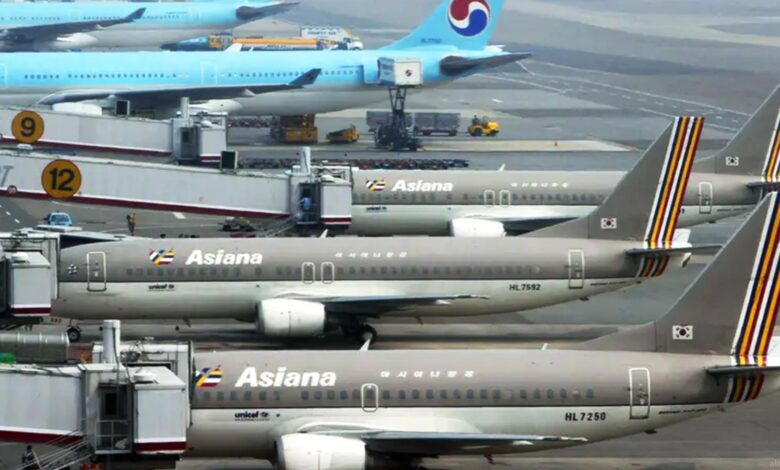
Korean Air Co., South Korea’s biggest airline, has successfully integrated smaller rival Asiana Airlines Inc. as a subsidiary, wrapping up a yearslong acquisition process, the company said Thursday.
Korean Air has invested 1.5 trillion won (US$1.04 billion) in 131.57 million shares issued by Asiana, or a 63.88 percent stake in the country’s second-largest full-service carrier, the company said in a statement.
The company concluded the share acquisition process on Wednesday after recently securing all necessary approval from antitrust regulators in 14 countries and regions, including the European Union.
The national flag carrier had initially announced its plan to acquire Asiana in late 2020.
Korean Air will absorb Asiana after a two-year post-merger integration (PMI) process, while its budget carrier unit Jin Air Co. will absorb Asiana’s low-cost units Air Seoul Inc. and Air Busan Co., a company spokesperson said by phone.
Asiana, Air Seoul and Air Busan will no longer exist after the PMI program is finalized, the spokesperson added.
To maximize business synergies, the integrated Korean Air will diversify time slots on redundant routes and open new routes, while maintaining the current workforce after the PMI period, the statement said.
It also plans to report the conversion ratio of mileage points between the two carriers to the Fair Trade Commission (FTC) by June next year.
On the same day, the FTC ordered some corrective measures as a condition for Korean Air’s acquisition of Asiana to address competition concerns.
The main conditions include a requirement for the two carriers to maintain at least 90 percent of the seating capacity offered before the merger on key routes.
To mitigate potential competition issues, the FTC has mandated that the airlines ensure seat availability on 40 routes does not fall below 90 percent of their 2019 levels.- Yonhap News Agency