Aviation worldFeaturedFlights
This small airplane could hold the key to zero-carbon flying
As the climate crisis intensifies, the pressure on the aviation industry to cut emissions increases. And now, the industry has taken a step forward, with a successful test flight of a hydrogen-electric engine, which produces no carbon emissions.
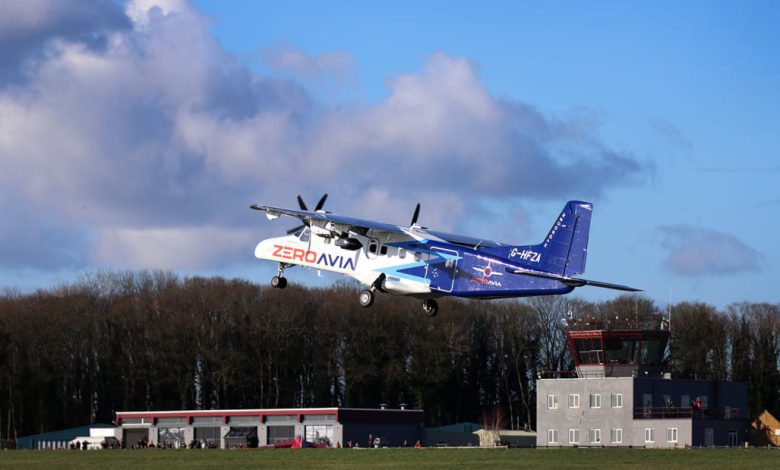
ZeroAvia’s 19-seater Dornier 228 twin-engine aircraft completed a roughly 10-minute test flight on Thursday in the UK. While 19 seats is, of course, tiny compared to regular passenger aircraft, it is the largest aircraft to have made a successful flight powered by hydrogen-electric.
Using liquid hydrogen to feed fuel cells, the technology eliminates carbon emissions during the flight.
This is part of a race to decarbonize the aviation industry, which currently accounts for around 2.5% of global carbon emissions, although its overall contribution to climate is estimated to be higher, due to the other gases, water vapor and contrails it emits.
Hydrogen has been identified as a promising fuel solution for planes because it produces no greenhouse gases when burned. However, unless the hydrogen is produced using renewable energy, the process for creating it relies on fossil fuels.
The Dornier 228 was retrofitted with a full size prototype hydrogen-electric powertrain, containing two fuel cell stacks, on the aircraft’s left wing. Lithium-ion battery packs amped up support during takeoff, while hydrogen tanks and fuel cell power generation systems were placed inside the cabin, with the seats removed.
Half the power came from the fuel cells, and half from the battery packs, a company representative confirmed in a post-flight press conference.
The right wing carried a regular engine, for safety reasons — although it was not used during the flight.
Starting from Cotswold Airport, the airplane completed taxi, takeoff, a full pattern circuit and landing all on the hydrogen-electric engine. It reached a speed of 120 knots, or 139 miles per hour. “All systems performed as expected,” the company said in a press release.
For a commercial flight, of course, the hydrogen tanks and fuel cell power generation systems would be housed on the outside of the aircraft. The company now aims to finalize configuration and submit it for certification by the end of the year.
In a press conference, a company representative said that there were no plans “at the moment” to install the hydrogen-electric powertrains (the mechanism which drives the plane, including fuel tanks and engine) on both wings, but added “Everything is possible, and we are learning.” The company has yet to confirm its launch aircraft.
ZeroAvia’s flight is part of the UK Government-backed HyFlyer II project, which aims to develop a 600kW powertrain to allow zero-emissions flight for 9-19 seater aircraft, and is targeting a 300 nautical mile range. The flight was conducted under a full Part 21 flight permit with the UK Civil Aviation Authority.
The company has come a long way since September 2020, when it completed a hydrogen-electric powered flight of a six-seater Piper Malibu, using a 250kW hydrogen-electric powertrain. It has since completed over 30 flights with the smaller engine.
The company — which already has partnerships with seven aircraft manufacturers — has 1,500 pre-orders for differing engine variants, according to founder and CEO Val Miftakhov at the press conference. Up to 700 of them are for the size of engine that was trialed in the UK on Thursday. “We know the market is there for it, it’s now all about pushing this to the final design,” he added.