Tips for flying in the winter
Air aviation news – By JOHN MAHANY
Learning to fly in the Chicago area, I was exposed to cold weather flying from the start.
And many years later, when I was living in Kenai, in south central Alaska, I learned more about cold weather flying. We’re talking seriously cold, -40°F cold, and below. Bone-chilling cold!
With winter and cold weather upon us (at least in the northern half of the country), there are several things to consider about flying safely in these conditions.
Dress Warmly
Believe it or not, some pilots don’t dress properly for cold weather. Or they don’t anticipate a possible forced landing and they aren’t dressed for that.
Few things are worse than frozen fingers or toes.
As a pilot flying in Alaska, I learned about Bunny Boots, designed for the military, for survival in really cold weather. They are white (hence the name Bunny?) and keep your feet remarkably warm when it is well below zero.

I recommend dressing in layers, so you can shed layers as you warm up.
Also, a cold pilot tends to rush through the preflight to get the airplane started — and that’s a problem.
If you are lucky enough to keep your airplane in a hangar, that keeps it out of the wind and the elements and makes the preflight easier. There is no snow or ice on the airframe and it will be warmer. Better yet if you have a heated hangar to preflight in. But many don’t have that. I have never had that.
Some aircraft owners also have a preheater for their engine, which keeps the oil warm. That’s really helps on those cold mornings.

The Cold Affects Everything
When it’s below freezing, everything is affected: Engines, oil, components, tires, pilots, passengers, etc. You have to allow more time for the preflight.
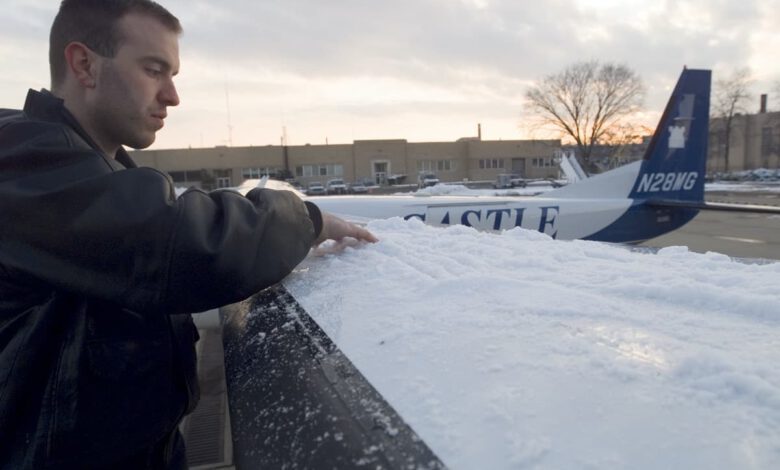
Build in time to remove the covers from wings and engines that keep snow and ice off or, if you don’t have these covers, time to remove that snow and ice.
Remember the rules that were adopted years ago, the result of an airline accident caused by airframe icing, in Roselawn, Indiana, known as the “clean aircraft” concept. This is spelled out in FAR 91.527, Operating in icing conditions, which states: “No person may take off an aircraft when frost, ice, or snow is adhering to the wings, control surfaces, propellers, engine inlets, or other critical surfaces of the aircraft.”

Cold Starts
Cold piston engines don’t like to start. And while turbine/turboprop engines are much easier to start, nothing likes to start in cold weather.
So make sure you follow the cold weather starting procedure for the airplane you are flying. It will be spelled out in the Airplane Flight Manual (AFM) or Pilot Operating Handbook (POH).
And be aware that if your airplane’s battery is weak, it will be harder to start — and you may only have one attempt before you have a dead battery.
30 Seconds
Did you know that most of the damage is done to piston engines in the 30 seconds AFTER a cold start.
That’s because it takes time for the cold oil to circulate through the frozen engine block and you have metal-on-metal in the cylinders until the oil is circulating.
If you don’t see any rise in oil pressure 30 to 60 seconds after start, shut down the engine, per the checklist.
Warm Up
Once your aircraft’s engine is started, allow time for it to warm up. There is nothing worse than trying to rush this process.
For the larger displacement piston engines, this is critically important.
Winter Runways
Runway conditions will depend on the airport where you keep your airplane. How is the snow removal? Many smaller airports have excellent snow removal equipment, equipping many smaller trucks with plows. But some do not.

See if the runways are cleared of snow. If they are not, check the performance section of your AFM/POH and see what kind of a correction to add for snow-covered runways, sometimes referred to as either “contamination” or “clutter.”
Generally, acceleration will be slower on a snow-covered runway, depending on snow depth, so a longer runway might be required.
If you are flying from a larger airport that has airline flights, get familiar with “SNOTAMS,” which detail the condition of runways and taxiways when it snows.
Give me a brake
SNOTAMS also address braking action reports, which changed after a December 2005 accident when a Southwest Boeing 737 touched down too far down the runway at Chicago’s Midway Airport (KMDW) during a winter snowstorm. It went off the end, striking three cars, resulting in one fatality, while trying to slow down.
Aircraft Performance
On the bright side, aircraft performance will be much better in colder weather, of course, as colder air is denser. This will result in a shorter takeoff roll and a better climb, as the engine produces more power when the temperatures are colder.
Landing performance will be affected as well, depending on the runway, and any snow that has accumulated, as well as any braking action reports.
But remember, this is not the time to try for a “smooth” landing to impress your passengers.
Instead, in these weather conditions, you want to touch down firmly on the runway, in the touchdown zone. Let the tires start to roll or spin up before carefully applying the brakes, so they don’t lock up. This will also help you avoid any hydroplaning that may occur on a wet, icy runway.
After you land and slow down, the tower may ask you for a braking action report after you clear the runway. This is critically important information for the aircraft following you. Please, tell it like it is, so the pilot landing after you knows what to expect.

Learn More — For Free
If you’d like to know more about safe flying in winter conditions, check out NASA’s free online training, “A Pilot’s Guide To Inflight Icing.”
While the course is primarily intended for general aviation pilots who fly aircraft certified for flight in icing, much of the information is applicable to all pilots, according to NASA officials.
And while its title says “inflight icing,” the course offers many tips and tricks for preflight, including a lot of information about checking the weather, ground operations, and what to do in emergency situations.
You can find the free course at AircraftIcing.GRC.NASA.gov