The young CFI’s wife was worried. Her husband hadn’t called.
He was scheduled to fly a discovery flight up over the Knik Glacier and down the Eagle River Valley in the mountains northeast of Anchorage from noon until 2 p.m., he had another student at 3 p.m., and he had promised to call her in between to arrange the details of a flying date they planned for that evening.
But it was now after 3 p.m., and no call. It was not like her husband not to call when he promised, so she called the flight school where she also worked running the front desk.
His car was in the parking lot, but his assigned airplane, a 1982 Cessna 172P, was not at its tie-down. It was also not like her husband to be late for a lesson.
She opened her Life360 family tracking app on her smartphone to check his flight track. His plane had stopped moving at 1:19 in the afternoon in the mountains of the Chugach State Park.
The Flight and The Pilots
It was a scenic flight over the stunning Alaska wilderness, but it was also a job interview of sorts.
In the left seat was a 27-year-old former flight attendant who won a battle with cancer and was now pursuing her dream of working in a different part of an airliner. She had already earned her private certificate and her instrument rating, and was now shopping for a school for her higher certificates and ratings.
Romance had brought her to Alaska.
In the right seat was the CFI. He was young at 23, but had the standard Commercial/Instrument/Multi package, and had already racked up 500 hours. He was a local kid and knew the mountains both in the air and on the ground. Alaska aviation was in his DNA — literally. His dad flew for Alaska Airlines.
The Accident
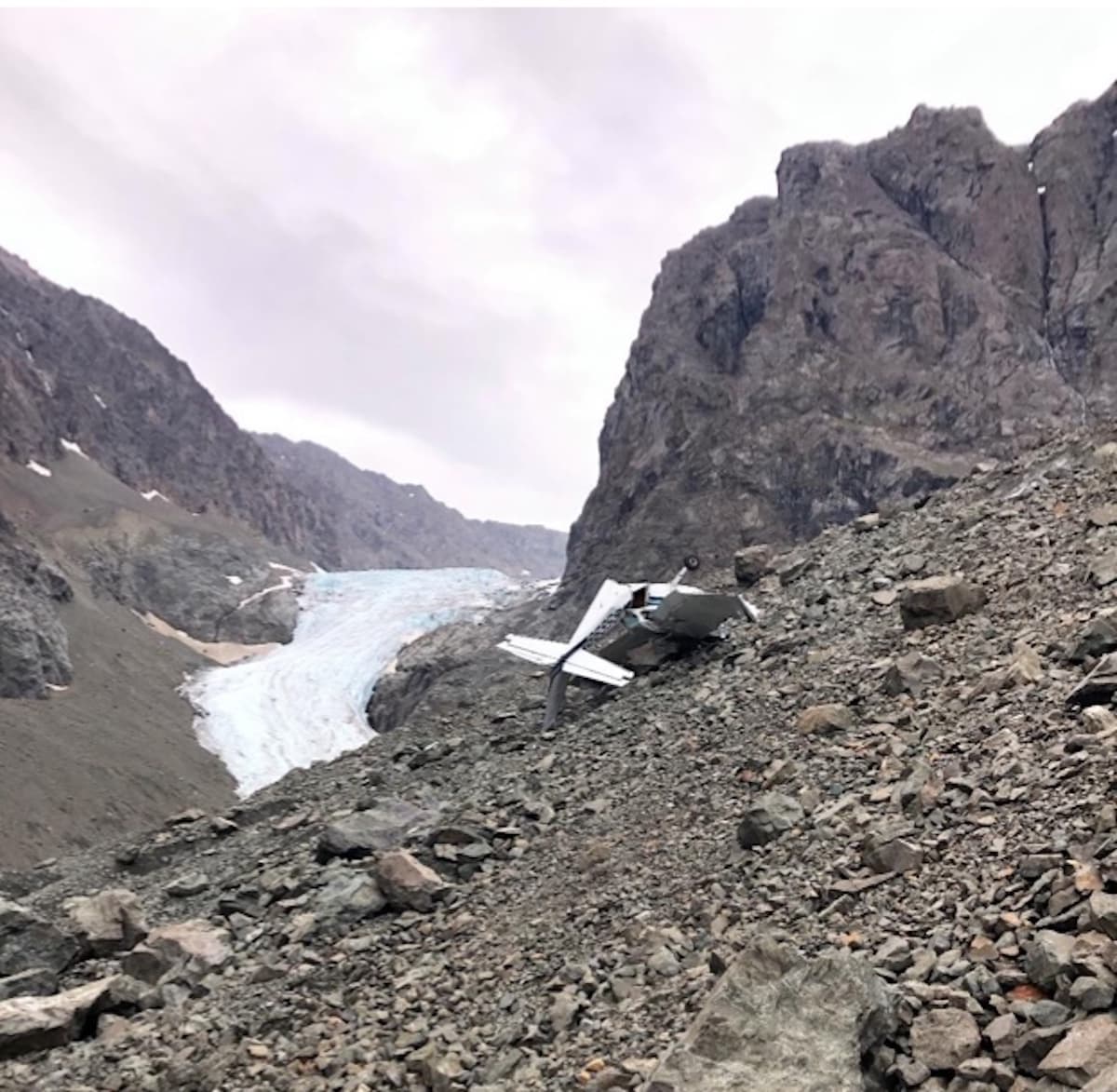
The wreckage was finally located nearly nine hours after the airplane’s scheduled return — 10 hours after the accident — just before sunset, which is nearly 11 p.m. that far north in the summer.
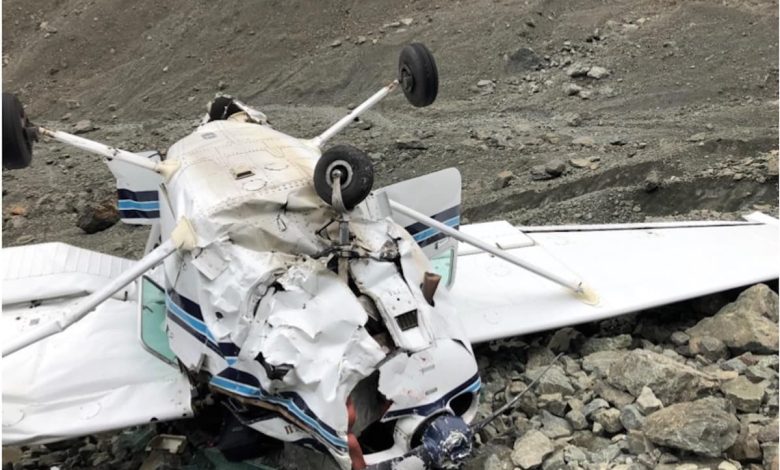
The mangled Cessna was lying inverted on sharp, jagged rocks to one side of a steep, wide canyon. The fuselage and left wing were heavily damaged, but there was no fire.
Both pilots were dead.
But despite a two-year investigation, the NTSB still doesn’t really know what caused the fatal crash.
The airplane did not appear to have suffered any sort of pre-accident failure.
The propeller blades were both missing about two inches of their tips and “exhibited leading-edge gouging and torsional twisting, chordwise striations across the camber surface, and trailing edge ‘S’ bending, all of which is consistent with rotation under power at the time of impact.”
In plane English: The engine was running at the time the plane smacked into the ground.
The conditions were ripe for carb ice, but other than that, the weather, for Alaska, was largely good. The visibility was nine miles, and there were few clouds.
In the end, all the investigatory board could come up with was: “An inflight collision with terrain under unknown circumstances.”
But that’s not the whole story. Because one thing did malfunction on the downed Cessna: The emergency locator transmitter or ELT.
It wouldn’t send its signal to the Alaska Rescue Coordination Center until the next day, after the bodies of the two pilots had been recovered.
An ELT, the FAA alleges, that was made from essentially counterfeit parts, with the full knowledge of the manufacturer.
The ELT
You might have read about it. In late 2015 the FAA issued an emergency “cease and desist” order against Ameri-King Corp., a major manufacturer of ELTs.
The order stripped the company of its Technical Standard Orders Authorization (TSOA) and Parts Manufacturer Approval (PMA) status, effectively barring its products from being installed in certificated aircraft. The agency also banned the company from manufacturing, selling, or distributing any parts for certificated aircraft or even rebuilding or making repairs to its existing gear.
In March 2016, the FAA followed up by issuing an Unapproved Parts Notification to aircraft owners, operators, manufacturers, maintenance shops, and parts distributors and suppliers that said, “it appears Ameri-King Corp. may be continuing to produce parts and articles represented as TSOA or PMA approved despite the emergency cease and desist order.”
The agency made it clear that anything produced by Ameri-King after Dec. 28, 2015, was verboten in certified aircraft, and even went so far as to cast doubt on gear that was manufactured earlier.
All of this came out of an investigation into what appeared to be a higher failure rate of Ameri-King ELTs, compared to those made by other manufacturers which, in turn, led to the discovery that the manufacturer was using unapproved parts in its gear, and passing them off as the Real McCoy.
Ameri-King effectively folded shortly afterward, but the FAA wasn’t done.
In the summer of 2016 the agency started the process for issuing an Airworthiness Directive (AD) requiring a higher level of annual inspection for earlier Ameri-King ELTs than the standard annual inspection of the devices required by 14 CFR 91.207 (d) — an AD that was adopted the following summer.
At the time, Ameri-King ELTs were standard equipment in Beech, Cessna, Cirrus, Diamond, Mooney, and Piper aircraft, along with a host of others. When the FAA issued its AD on the ELTs, the agency estimated that there were 14,500 of them installed in U.S. registered aircraft.
The agency didn’t pull any punches with its wording that the goal was for non-functioning Ameri-King ELTs to “be eliminated from the U.S. fleet.”
And yet…
An Unexpected Twist
When the NTSB dug into the accident airplane’s maintenance logs the investigators found something disturbing. The logbooks showed that the airplane’s AD-affected Ameri-King ELT had been removed and replaced with an Artex 1000 ELT a year and a half before the wreck.
But the ELT in the crumbled Cessna was not an Artex. It was still the old Ameri-King.
Equally disturbing — or maybe more disturbing, I can’t make up my mind — a year later, a different mechanic signed off a standard 91.207 inspection on the non-existent Artex unit.
The NTSB tested the wrecked Cessna’s Ameri-King ELT and found that while it worked fine in the ON mode, when tested in the ARMED mode — which is the operational mode in flight — it only transmitted a single time in two dozen tests. Just the sort of failure that prompted the FAA actions against Ameri-King.
Why does all of this matter?
In the Ameri-King AD, the FAA stated its concern: “We consider this an unsafe condition since nonfunctioning ELTs could delay or impede the rescue of the flight crew and passengers after an emergency landing.”
Words that would prove eerily prescient five years later. At the time of the accident, the CFI was wearing an Apple Watch, which survived the crash and was later downloaded.
It recorded an active heart beat for about two and a half hours after the crash.
Analysis & Discussion
The final report from the NTSB reads, “had the AD-affected ELT been removed and replaced with a functional unit as was noted in the maintenance records, the search and rescue response likely would have been faster.”
Does that mean that the CFI, and perhaps his passenger, could have been saved?
The NTSB tried to figure that out, ordering a study of the pilots’ injuries to “analyze whether the outcome of those injuries may have been more favorable had the emergency locator transmitter functioned correctly.”
The results, however, were inconclusive, with the report admitting, “whether faster location of the wreckage would have prevented a fatal outcome could not be determined.”
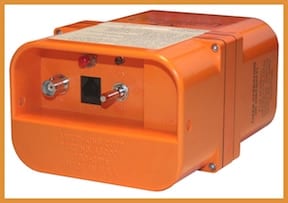
What about the mechanic who logged the ELT as replaced? And the one after him that apparently didn’t inspect the ELT well enough during the annual inspection to notice that not only did the serial numbers not match, neither did the battery expiration date or even the brand.

Hell, the two different ELTs aren’t even the same color! Ameri-Kings were blaze orange, while Artex units are neon yellow-green.
Is there blood on their hands?
And what about the crash itself? What role did the pilots play in it?
The CFI knew the mountains, and having more than one pilot is a proven boost to safety, but with an official finding of “an inflight collision with terrain under unknown circumstances,” and nothing else to go on, there’s not much to discuss except, perhaps, carb ice.
The weather conditions were ripe for it, and the carb heat was found in the “ON/HOT” position in the wreckage.
But that said, we have no way to know if the plane actually experienced carb ice. Perhaps the CFI was just being proactive in using it. And even if the Cessna did experience some carb ice, was it bad enough to bring the airplane down?
The NTSB investigators didn’t seem to think so.
As for the wreck’s location close to one side of the valley, that’s standard operating procedure for flying mountain valleys.
The Takeaway
So what’s the takeaway here? What can we learn from this tragedy?
Well, for one thing, I guess it shows the FAA was justified in its concerns about the Ameri-King ELTs.
It also reinforces the need to verify the work of others. Not that I’d expect the CFI to open up the airplane and compare the ELT to the logs, but the second mechanic sure as hell should have.
In fact, he was required by the regulations to check it for proper installation, battery condition, and operation of the controls and crash sensor. Most A&Ps test for signal strength by bench-testing the units as well as testing them installed. How could the second mechanic not have noticed the ELT didn’t match the logs if he actually did the work?
But for us as pilots, is there anything here to learn? I really wish there was, because I truly believe the purpose of studying tragedies like this is to improve our own safety.
But, in this case, I confess, I’m coming up blank. Readers, chime in: What is there to learn here?
The Numbers
Want to read more? You can see the NTSB’s final report here or view the items on docket here.